A Structured Record of Method.
The Tarlone approach to behaviour change follows a documented sequence. Each stage is recorded, reviewed, and refined in relation to the individual's specific pattern set — not applied as a generic template.
Initial Habit Audit
The first stage involves a structured observation of existing daily patterns. Rather than asking what the individual wants to change, the process begins by mapping what is already present — morning anchors, energy troughs, consumption triggers, and the sequence of the current day.

Pattern observation · Initial audit, Session 01
Cue-Routine-Reward Mapping
Once the audit is complete, the second stage isolates the three-component loop operating within each identified pattern. The cue — the trigger that initiates the sequence — is distinguished from the routine and the reward. This separation is the prerequisite for any subsequent substitution work.
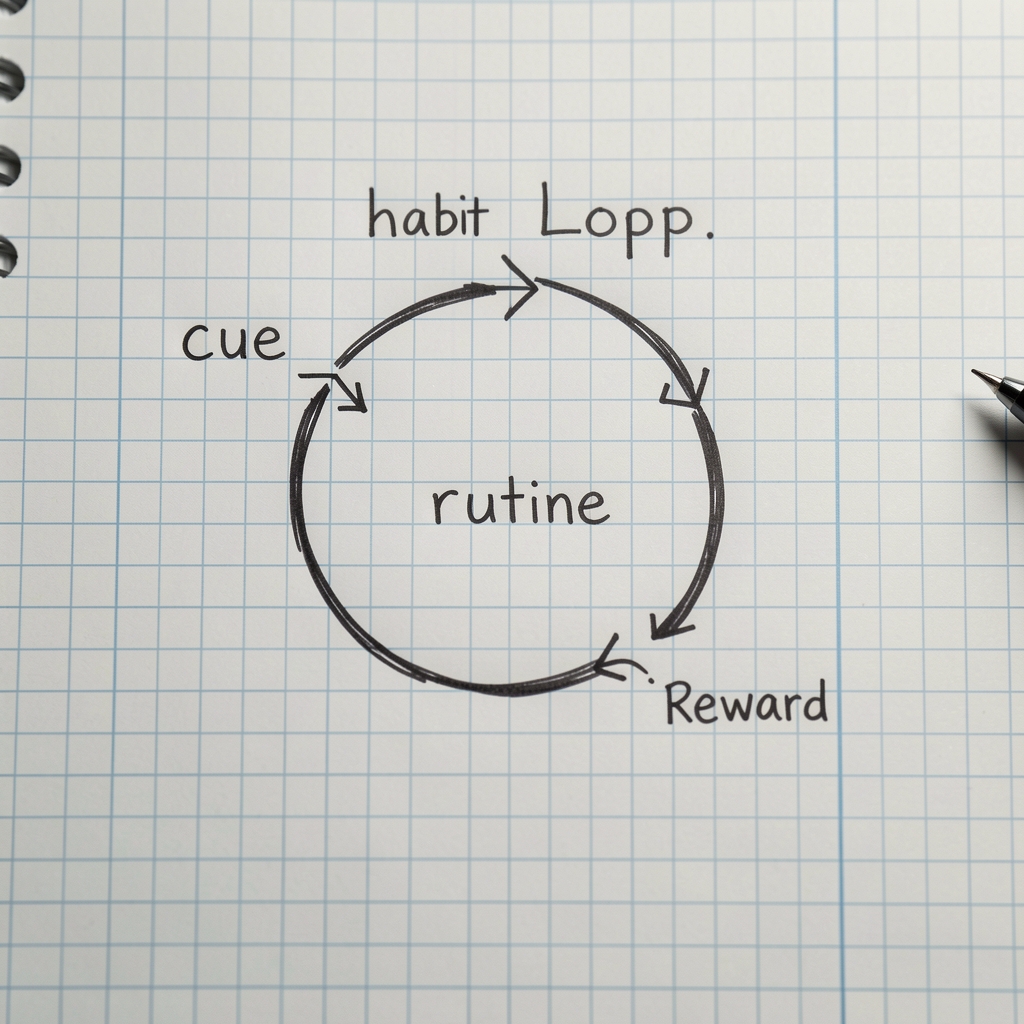
Loop documentation · Cue-routine-reward record
Routine Replacement Planning
Substitution preserves the existing cue and reward while replacing only the routine component. This is less demanding on willpower than whole-pattern elimination. Candidate replacement routines are evaluated for friction, accessibility, and compatibility with the individual's current environment before being incorporated into a draft daily structure.
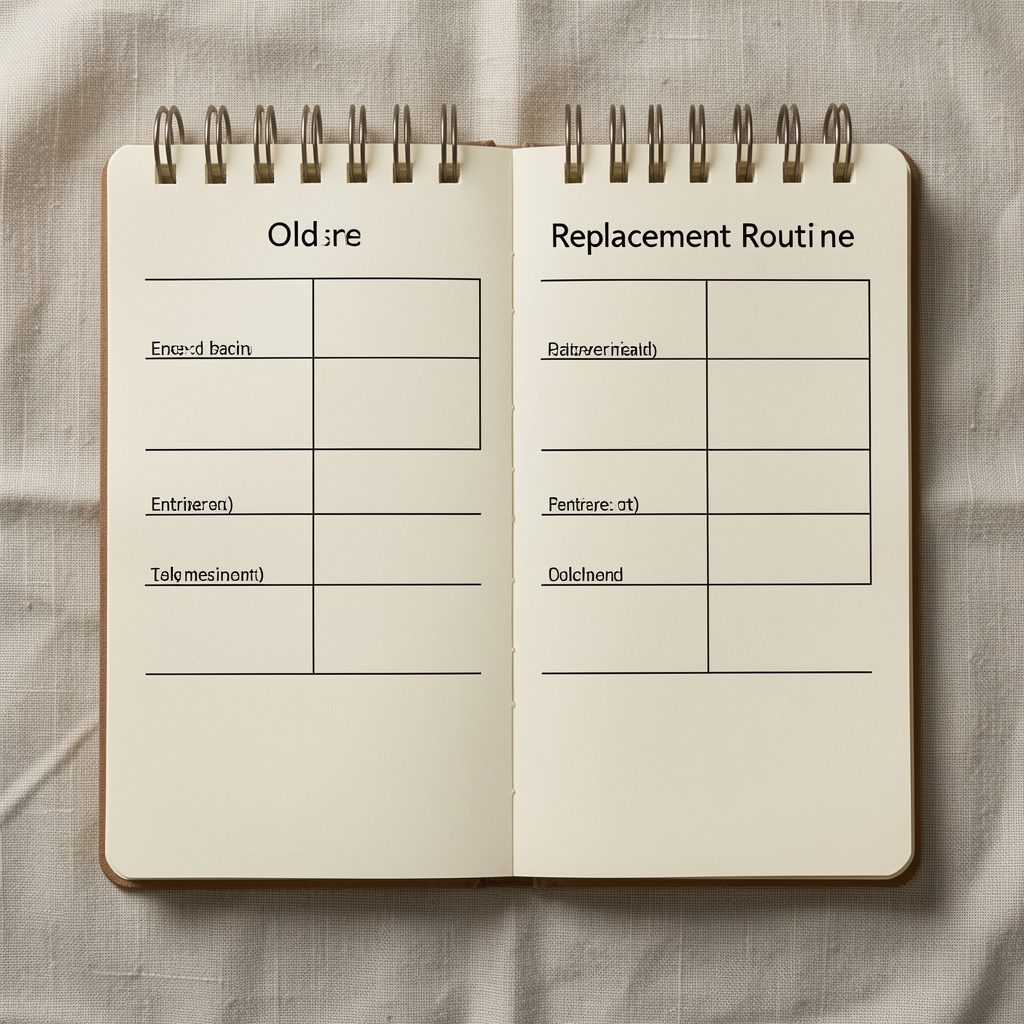
Substitution planning · Draft structure entry
Context Restructuring
The physical and digital environment is reviewed for friction points. Objects, notifications, and spatial arrangements that reinforce unwanted patterns are identified and adjusted. Equally, environmental cues that prompt the replacement routine are deliberately introduced — a practice referred to as context seeding within the Tarlone documentation framework.

Context restructuring · Environmental record, morning setup
Habit Stack Architecture
Once a replacement routine is stable, it becomes an anchor for additional behaviours through the habit stacking process. New patterns are appended in sequence — before or after the anchor — using the existing automaticity of the anchor as the initiating cue. Stacks are limited to three behaviours per anchor to avoid overload during the consolidation window.

Habit stacking record · Stack architecture, Week 03
Consistency Documentation
Sustained observation across an extended period allows for identification of contextual disruptions — travel, seasonal shifts, social changes — and their effect on the pattern set. The record is reviewed at fixed intervals, and the documented history informs adjustments. Consistency over perfection is the operating principle: a partial record is more informative than no record.

Longitudinal review · Archive entry, 12-week record
How the Record is Maintained.
Every engagement produces a written record. Session notes follow a consistent structure: observed patterns, identified loops, proposed substitutions, environmental adjustments, and progress observations. These entries are archived in a dated sequence that allows retrospective analysis without relying on memory.
The documentation standard is informed by the principle that long-term behaviour shift is better understood through a longitudinal record than through periodic assessment. A single session reveals a snapshot; a twelve-week record reveals the structure of a pattern — including its seasonal and contextual dependencies.
Participants receive a copy of their session notes at each stage. The record belongs to the individual and is structured to remain useful independently of the engagement — a resource for their own continued observation beyond the programme period.
Structured using a four-field template: observed pattern, loop components, substitution candidates, and environmental notes. Dated and filed under participant reference.
Formal review at weeks 3, 6, and 12. Intermediate check-in at week 1. Each review compares current observations against the initial audit, not against an external standard.
If a substitution routine is not holding after three weeks, it is revised rather than abandoned. The revision record is appended to the original entry — not replaced — maintaining a complete history of the engagement.
All documentation is provided to the participant in plain format at each session. No proprietary system is required to access or use the records after the engagement concludes.
What the Framework Draws On.
The Tarlone methodology draws on published research in behavioural psychology, specifically work concerned with the automaticity of routinised behaviour and the conditions under which stable patterns form and dissolve. The framework is not a proprietary invention — it is a structured application of well-documented principles, adapted to individual circumstances.
Key concepts informing the methodology include the habit loop model, the role of dopamine in reinforcing repeated sequences, and the documented relationship between environmental cues and the initiation of routine behaviour. The small steps approach and identity-based framing are incorporated where they are consistent with the individual's stated orientation toward change.
Where newer research on long-term behaviour shift and daily routine optimisation is relevant to a particular engagement, it is referenced explicitly in the session documentation rather than incorporated into the framework as a general claim. Specificity over generality is a documentation standard across all Tarlone work.
Research References
All research referenced within the Tarlone framework is drawn from published, peer-reviewed sources. References are provided in session documentation where they inform a specific substitution recommendation or scheduling decision.
Framework Materials
Worksheets, audit templates, and habit stack frameworks used in the programme are produced internally. They are plain-format documents requiring no specialist tools to use. Participants retain these materials in full at the conclusion of the engagement.
Ongoing Assessment
The Tarlone methodology is reviewed periodically against current published understanding of behaviour change. Where significant shifts in the evidence base occur, the framework documentation is updated and versioned. The revision history is maintained in the archive.
“The record is not a measure of success. It is a map of the terrain — including the detours.”
Tarlone Working Notes — Documentation Principles
An Initial Conversation.
The methodology works best understood in the context of a specific pattern. An introductory conversation allows the process to be considered relative to an actual habit rather than in the abstract.
Get in Touch