
Tarlone Specialist · London practice, established
Foundations in the Field.
The Tarlone practice was founded on a simple observation: that most guidance on habit change approaches the problem from the wrong direction. It begins with aspiration and works backwards toward the current state. Tarlone begins with the current state and works carefully, methodically forward.
The specialist behind Tarlone brings a background in applied behavioural research, with particular attention to the intersection of environmental design, cue architecture, and dopamine-driven feedback loops. The practice draws on published literature without dressing it in the language of transformation — that register belongs elsewhere.
Sessions are conducted in London and remotely. The approach is deliberate, structured, and calibrated to the individual's actual daily context rather than an ideal version of it.
Audit First
No replacement strategy is introduced before the existing pattern is documented in full. The audit phase is non-negotiable.
Small Steps
Each new element introduced into a routine is sized to require minimal willpower. Scale comes later, after automaticity is established.
Consistency Over Perfection
A missed day is noted, not mourned. The record continues the following morning. Rigidity is a fragility — the programme accounts for interruption.
Evidence-Based
Every framework is grounded in published behavioural research. References are available on request. No claims are made beyond what the literature supports.
A practice shaped by observation, not ideology.
The work behind Tarlone developed over several years of close attention to how individuals actually navigate their days — not how they describe their intentions, but what the daily record shows when the gaps and repetitions are mapped. The patterns are surprisingly consistent across very different contexts.
That observation — that unhelpful routines are not failures of willpower but rather well-formed habits that simply serve the wrong purpose — sits at the centre of the Tarlone approach. The cue-routine-reward loop is neutral. It does not care what the routine contains. The work is a matter of substitution, not elimination.
Early work focused almost entirely on morning routine architecture. Over time it became clear that the evening wind-down was equally important — perhaps more so, because the quality of the morning is substantially determined by how the previous evening closed. The two-end approach is now standard across all Tarlone programmes.
Screen time reduction and mindful consumption — particularly around caffeine and sugar — entered the practice as recurring themes that clients raised independently and repeatedly. Dedicated frameworks for both were developed from the existing methodology and are now offered as standalone components or integrated within the longer programmes.
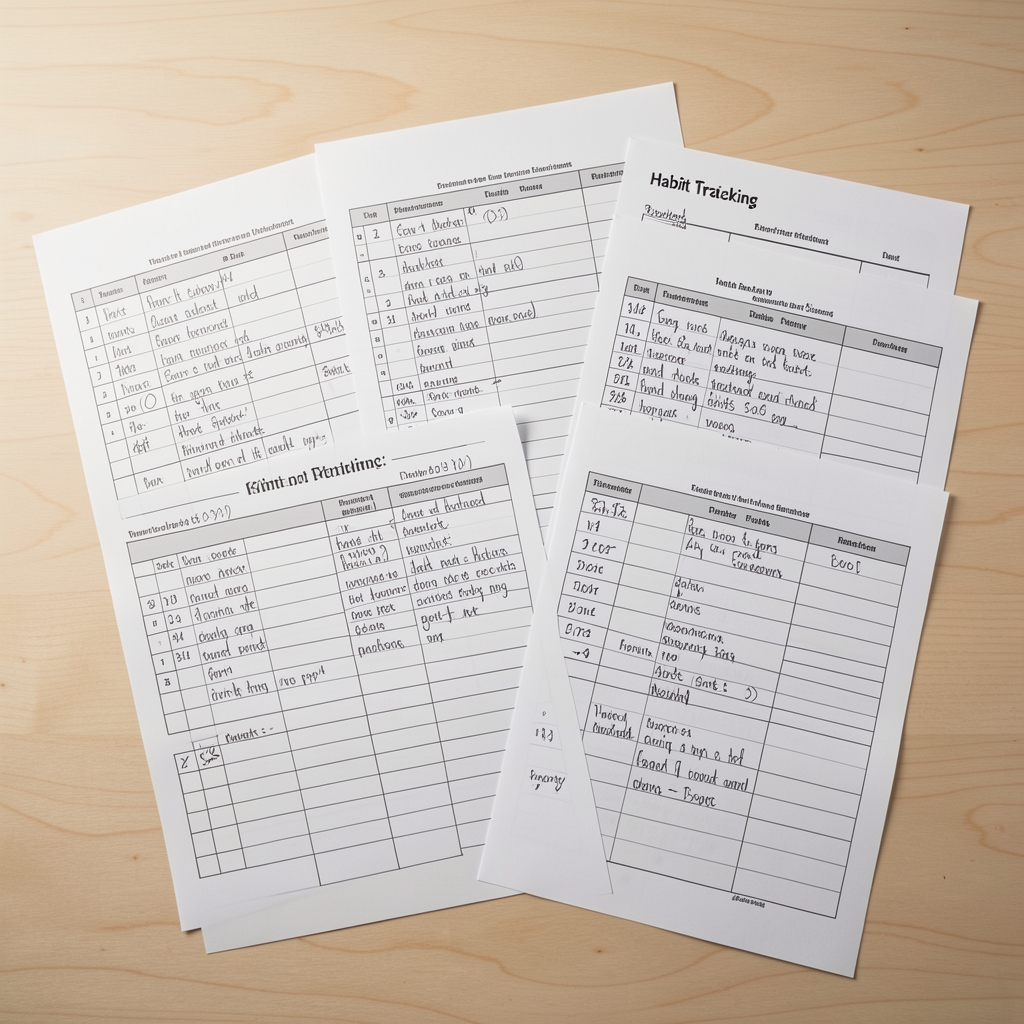
Daily log sheets · Pattern audit, archive ref. 2024

Twelve-week schedule · Habit stack documentation
How the Tarlone framework developed over time.
Mapping Daily Patterns
Early practice focused on detailed observation — recording daily behaviour across multiple participants to identify the structural patterns common to both productive and counterproductive routines.
Building Structured Approaches
Observations were cross-referenced with published behaviour-formation research. The cue-routine-reward model was adopted as the structural basis, with additional layers for environmental factors and dopamine-cycle timing.
Calibrating for the Individual
Generic frameworks were tested against individual contexts and revised repeatedly. The finding that emerged most clearly: the smaller and more specific the initial change, the more reliably it embeds. Scale is a later stage, not a starting condition.
Tarlone in London
The practice now offers five structured programmes, each with a defined session count, journaling component, and review structure. Sessions run in-person at the London premises on Seymour Place, and remotely for participants outside the city.
No grand programme. Only a carefully kept record.
The language used in this practice is deliberately spare. There are no transformation promises. There is no before-and-after narrative. What there is: a structured process, a reliable set of frameworks, and a consistent record of what works when applied with patience.
Behaviour change is not an event. It is a slow accumulation of small, unremarkable choices made in roughly the same direction over a sustained period. Tarlone documents that process. The specialist keeps the structure. The individual keeps the record.
We recommend speaking with a qualified wellness or nutrition professional before introducing any significant change to your daily routine, particularly if you have specific dietary requirements or existing health considerations.
Begin a Conversation


Tarlone operates as a structured guidance practice, not a regulated wellness service. Guidance provided through this practice is grounded in published behavioural research and is intended to support positive daily routine development. It is not a substitute for qualified professional advice regarding individual health conditions.